There are times in your life that you never forget. Last night our team experienced one of those "life" moments. A memory that will stay with us forever.
The blokades in Potosi had begun to let up around seven in the evening so we ate a quick meal and hopped into two taxis. The plan was to go from Potosi to Sucre and in the morning to catch a plane from Sucre to Cochabamba. Two hours later we were at the outskirts of Sucre. Cars and Trucks lined the sides of the road and traffic was stopped. We had run into a blockade. It took us a few minutes to unload our gear and pay the drivers.
A constant stream of people made their way towards Sucre. It reminded me of some mass immigration you would see on television after some disaster had occured. We walked, luggage and all, for about a kilometer or so. The blockades we had seen before had been people blocking the streets. This time, in addition to people, there were rocks, branches from trees, and burning tires in the streets. We had some difficulty getting our luggage through it all but, we made it!
It was a sureal experience but, I want to stress that we never felt in danger. It was a bit scary but, it was also exciting to see this unique cultural form of democratic expression.
We decided to take a cab to our hotel. We packed all five of us, the driver, and all of our luggage into this tiny taxi. I had the joy of sitting on the emergency brake and having intimate contact with the stick shift everytime the driver switched gears. Soon we were at the hotel and had a chance to relax.
All in all, we made it safely to the hotel and we have a memory we will never forget.
Saturday, April 16, 2011

Friday, April 15, 2011
Anne:Oh, Potosi, Potosi

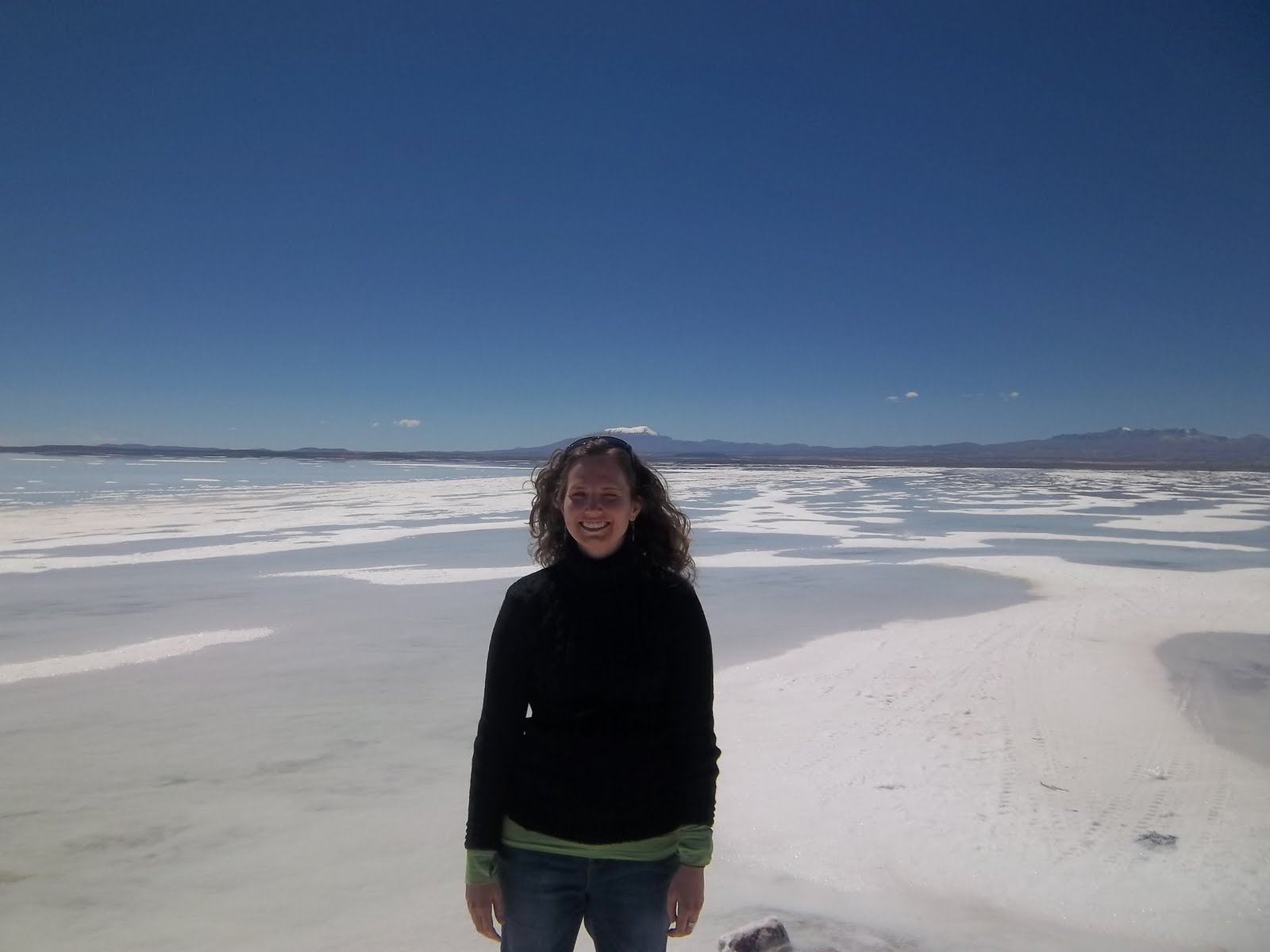
Well, we have been in Potosi since Monday. We have been treated well and have seen some beautiful things. For example, we went to the Salar (salt flats) in the country. It took about 3 hours to get there. It was a long journey, especially for Judah and Doug who were cramped in the converted trunk made for children. We bonded as a team by playing cards and silly car games. When we got to the Salar, we ate lunch at a salt hotel. It was very primitive, mainly for camping types. There wasn't any toilet paper or showers and people had to bring their own food. Yes, it was like camping. =) Anyway, some of the photos were like looking at the Carribbean, except it was water on top of salt. The water made the horizon look like a giant mirror.
It was an interesting day. All of our toilet were awful. I guess we've been spoiled with nice homes with all the aminities. I had to scoop water from a large buck in 3 bathrooms to pore into the toilet to make it flush. Wow! The floors were a mixture of urine and water splashed from the large buckets. I'm throwing my shoes away as soon as I get home. As many of you know, I'm a trooper with roughing it. I'm just making light of the situation. =)
The picture of the march is why we are still in Potosi. Teachers are protesting and creating blockades out of major cities to inconvenience the government. This is so they can get more money. I think they want a 30% increase. Doug thinks we should try this in Virginia. HaHa!
Judah: Las Primeras Dos Semanas
As I had hoped, Bolivia is new, exciting, and challenging. If I had to summarize, I would call it a country of extremes: extremely high mountains, extremely friendly people, extremely delicious foods, and extremely beautiful landscape. All of our hosts have been most welcoming, treating us like royalty. Here are a few images that stand out in my mind- Santa Cruz: A tropical city at reminds me much of Miami in terms of lifestyle, nightlife, excitement. Our hosts were most gracious, wining and dining us, and showing us their most impressive projects to help burn victims (Cerniquem) and help educate kids in poor neighborhoods in the outskirts of this booming metropolis. Sucre: A beautiful colonial and university city where our group felt a bit more at home. It has a small town feel, and many gringos come here to learn Spanish. I was fortunate to visit the language academy where my host oversaw the operations. Their program was developed to teach students of all ages to be communicative in Spanish in as little as one to two weeks. Quite impressive, and I came away with some ideas for my own students. The highlight was our trip to the small town of Chaco, where Rotary Club de los Charcas was providing much needed healthcare and educational materials for free to all those in need (over 200 people). We spent the day helping sort medications and passing our clothes, books, and toys to most grateful recipients. 9 year old Wilbur who was wearing a Mexican soccer jersey became my best friend for the day and took me on a tour of his town and we ending up climbing up trees to pick guayabas, avocadoes, passion fruits and other unknown treats. Then we topped it all off with a cookout, great food, soccer, volleyball, music and dance… Potosi: A mining town once the economic center of the world due to its Cerro Rico, which continues to be one of the richest mines for silver, zinc, lead, tin…they continue to mine with pickaxes, dynamite, shovels, and wheelbarrows, walking miles into the small tunnels and spending the day (or the night) in dangerous working conditions (to say the least). But they pay a tribute to their Tio, sharing liquor, cigarettes, and coca with him so that he will keep them safe. The highlight of Potosi for me was joining two of Bolivia`s top cyclists on a training ride from Potosi to Miraflores, only 25km, but a vertical drop of over 2500 feet, where we enjoyed a bath in the hot springs. Then the ride back we had some serious climbing and it took all I had to keep up with these two 120 lb climbers. Now, we get to spend an extra day in Potosi since there are blockades preventing us from leaving. The public employees are demanding a raise in wages to keep up with inflation, and the president has not yet agreed. So, as is common in Bolivia, the people unite in protest. Not to worry, these have been nonviolent protests, and our hosts assure us that we will be able to leave this evening headed to Sucre and then fly to Cochabamba tomorrow morning.


Michael: Visiting the Salar de Uyuni
Yesterday’s excursion was one we all had been anticipating since we arrived. We were to visit the Salar de Uyuni. The Salar is an immense salt flat, 5 times larger than Bonneville. It is so vast, so reflective, and so consistent in elevation that it is used in the calibration of earth observation satellites.
Our original plan was to travel there by bus and stay for two nights in a hotel literally built of blocks of salt and located on the salt. Our hosts changed our plan and decided that one of the members of the Potosi Rotary Club would take us in his personal vehicle and bring us back the same day. We were told that the salt had some water on it, which would limit our mobility and make a full day there unnecessary. At least that’s what I think I heard from the mostly Spanish conversations.
So we all awoke at 4:00 a.m. It was around 5:00 a.m. when we rolled out of the city. Our host and his driver sat up front, Tamsen, Anne and I sat in the middle, and Doug and Judah sat in the far back in a late-model Acura SUV.
All of us would have been happiest to find whatever comfortable position we could and get a couple of hours of additional sleep. But our host put bass-heavy local music on the stereo at a volume that had me scurrying for my earplugs. When I could see that other team members were similarly uncomfortable, I finally asked our host to reduce the volume, which he cut by around 80%. The music, at this blissfully reduced volume, was our companion for the entire trip.
As the sunrise approached, I could see that we were in an area of large, scrub-covered mountains. The road wound through them like a ribbon, constantly attempting to moderate the elevation gains and losses. Most of the trip was between 12,000 and 13,000 feet elevation. The area was sparsely populated and there were few other vehicles on the road. In places, the road had two nicely paved lanes. But there were continual interruptions with dirt sections, particularly work-arounds where new bridges were being constructed. The area reminded me of the red-rock country of northern Arizona. It was stunning countryside!
We made a brief stop at an old mining town, where several locomotives (made in America) sat rusting in the abandoned yard. Our host said a Japanese company was coming into the area to reopen some of the mines. It was the first railroad I could remember seeing in the entire country. I tried to imagine the enormous engineering task of getting trains from here to the ocean ports.
Finally we crested a pass and descended into the Uyuni valley where the great salt flat spread out before us. We stopped at a cheap hotel in town where we had breakfast (eggs and toast – I declined to drink the hot chocolate made with local water) and used the bathroom (where the toilets had neither seats nor toilet paper). Later, we waited in the car while our host entered the market and bought makings for a picnic lunch.
We got back into the SUV and drove 5 more miles to the edge of the salt. It was clear that there was a considerable amount of water on it. We drove directly into the water and another couple of miles to the hotel of salt. Salty water splashed all over the car. Workers shoveled salt into piles for drying and eventual harvesting.
We arrived at the hotel and hung out for awhile, listening to all the foreign voices at this tourist attraction. There was a raised area of hardened salt where flags of many nations flew in the constant breeze. Everyone tip-toed around the large puddles of water and took lots of pictures, mostly of the surrounding mountains -- some snow-capped -- and the amazing reflectivity of the salt flat.
We entered the hotel where we had our picnic while sitting on salt chairs and before a salt table (with plastic table cloth, of course). Our meal was of an unidentifiable meat sliced from a large tube, served on white bread with mayonnaise and ketchup, watered down with Coca Cola.
We discussed options for further exploration. I was interested in seeing the flamingos that are at a nearby lake, but was told that was another 16 hours away. We finally decided to depart. We stopped in Uyuni again, where we walked the market while our driver had the car washed, which seemed to take two hours. Finally, we were on board again for the next four hour trip back to Potosi. The highlight was when the car was stopped so the guys could pee (When you’re a guy, the whole world is a urnal.) and a young llama came by to investigate. Cute guy!
We arrived back in Potosi in the dark around 8:00 p.m., exhausted.
Today is a travel day. We will take a bus or taxi for three hours back to Sucre, then fly down to Santa Cruz, then fly back up to Cochabamba.
Tuesday, April 12, 2011
Michael: trying a photo

I haven't sent any photos yet, so let's give this a try.
Potosi was once the richest city in the Americas due to the enormous quantities of minerals, primarily silver, extracted from a mountain that forms the backdrop of the city. Mining has been in continuous operation for 500 years.
There is a museum of mining on the mountain. The surprising thing is that the museum is INSIDE the mountain, with visitors using the same access portal as the working miners. Here's the team and our hosts, suited up for entry.
Michael
Michael: Moving up in the world
Yesterday, we departed Sucre for our next GSE adventure. This was a bitter-sweet moment for me because I liked Sucre and I adored my hostess, Patricia Rosales, and her family.
We boarded a bus in Sucre for a 3-hour ride to Potosi. I awoke with a headache, likely a result of my missing taking my blood pressure medication the previous day. I took some pain medication which made me drowsy for the trip, which likely was a good thing.
The first hour of the route was alongside a dry riverbed. The bus crossed the riverbed on a long bridge and began ascending the slope on the far side. It took 45 minutes to gain nearly 3000 feet elevation. Tall mountains, mostly of scrub plants, loomed all around. It resembled the mountains of Arizona. Eventually, we reached the Altiplano, or high plain. There were sparse settlements and farms where peasants worked gardens by hand, bent from the waste to pick potatoes and other crops. I saw only one piece of mechanized farm equipment: a tractor.
We were met by two Rotarians, Sady and Miguel. We had a nice lunch at Sady’s house and then visited a school for students with special needs. We entered a classroom where an expressive teacher used our presence to teach her children additional words in American Sign Language.
Last evening, we were invited to attend a concert featuring a pianist, a guitarist, and a musician playing sort of a miniature guitar, the name of which I’ve forgotten. My headache forced me to abandon my team and head “home” to bed. I’m eager to ask my team about it this morning.
Potosi is not as attractive a city as Sucre, pasted on the slope of a mountain devoid of trees and greenery. However, it may be the most historically interesting city in all of the Americas. There’s far too much to recount here, but the silver in the mountain that forms the backdrop of the city made Potosi one of the largest and richest cities in the world 500 years ago. Potosi was bustling before Jamestown was even formed. This morning, we are scheduled to attend a museum of the mining industry.
Hasta luego!
Michael
We boarded a bus in Sucre for a 3-hour ride to Potosi. I awoke with a headache, likely a result of my missing taking my blood pressure medication the previous day. I took some pain medication which made me drowsy for the trip, which likely was a good thing.
The first hour of the route was alongside a dry riverbed. The bus crossed the riverbed on a long bridge and began ascending the slope on the far side. It took 45 minutes to gain nearly 3000 feet elevation. Tall mountains, mostly of scrub plants, loomed all around. It resembled the mountains of Arizona. Eventually, we reached the Altiplano, or high plain. There were sparse settlements and farms where peasants worked gardens by hand, bent from the waste to pick potatoes and other crops. I saw only one piece of mechanized farm equipment: a tractor.
We were met by two Rotarians, Sady and Miguel. We had a nice lunch at Sady’s house and then visited a school for students with special needs. We entered a classroom where an expressive teacher used our presence to teach her children additional words in American Sign Language.
Last evening, we were invited to attend a concert featuring a pianist, a guitarist, and a musician playing sort of a miniature guitar, the name of which I’ve forgotten. My headache forced me to abandon my team and head “home” to bed. I’m eager to ask my team about it this morning.
Potosi is not as attractive a city as Sucre, pasted on the slope of a mountain devoid of trees and greenery. However, it may be the most historically interesting city in all of the Americas. There’s far too much to recount here, but the silver in the mountain that forms the backdrop of the city made Potosi one of the largest and richest cities in the world 500 years ago. Potosi was bustling before Jamestown was even formed. This morning, we are scheduled to attend a museum of the mining industry.
Hasta luego!
Michael
Subscribe to:
Posts (Atom)